George Koehler was cussing to himself.
It was late September in 1984 and Koehler, who owned a limousine service, was at his usual post at O'Hare Airport, holding up a sign for a customer. But as the flight emptied, no one approached him.
"I had just spent 45 minutes parking the car, not to mention paying for parking," Koehler recalled. "Finally, the pilots got off the plane and I asked one of them if there was anyone else aboard and he said, 'Just one more guy. He'll be off in a minute.'
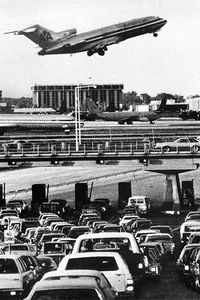
"I waited a few more minutes and then down the tunnel walks Michael."
A Bulls fan, Koehler, then 29 years old, recognized the skinny 21-year-old top draft pick from North Carolina who had lagged behind to sign autographs for the flight crew. Well, almost recognized him.
"I was excited because I knew who he was and I thought, 'Holy smokes, it's Larry Jordan,' " Koehler said. "I played four years in high school with a guy named Larry Jordan so that name was stuck in my memory bank.
When I saw Michael, I said, 'Larry Jordan.'
"He turned to me and said, 'How do you know my brother?' Obviously, I didn't know he had any siblings, much less one named Larry."
Once they cleared that up, Jordan told Koehler he was going to look for a taxi.
"I just wanted to pay for my parking," Koehler said, "so I said, 'I have a limo. I'll take you anywhere you want to go for 25 bucks.' "
Koehler sensed that his passenger was a little uneasy. "I looked in the rearview mirror and I couldn't even see him because he was scrunched down like a little kid," he remembered. "I don't know if he'd been in a stretch limo before; he didn't know anyone in Chicago, I was a stranger and he was obviously a bit nervous that I could drop him off in an alley somewhere."
Instead, Koehler dropped him off at his destination, the famous purple Lincolnwood Hyatt House, not far from where the Bulls practiced at Angel Guardian Gym. Jordan gave him 50 dollars and told him to keep the change, and Koehler gave him his card.
"I told him, 'If you need to know of any places to live, restaurants to eat, you want to go out for a beer, you've got a friend in Chicago. And oh, by the way, congratulations on your gold medal.'"
Two weeks later, Koehler's phone rang.
"I heard, "Georgie, my boy,'" Koehler recalled. "I'm going, 'Who's this?' and he says, 'It's MJ.' I said, 'I don't know any MJ.' And he says, 'Yes, you do.' And I'm like, 'I'm not going to argue, I don't know who this is."
"And he's like, "Dumb [expletive delete], it's Michael Jordan.' I could hear him grinning."
Jordan asked Koehler to pick his parents up from the airport the next day for his first game and the two struck a handshake deal with Koehler taking him back and forth to O'Hare for road trips all season, after which they would return to Jordan's townhouse in Northbrook, where they would spend hours talking.
"We became friends that way," Koehler said. "And 25 years later I don't drive the limo for him, but we're still really close friends. I've met just about everyone under the sun through Michael. If you picked up a book about Michael's life, it would be my life, just Michael's name on the cover. I don't know if you believe in fate, but I obviously do. My whole life could've been different if my customer had showed up that day.
"Michael likes to tell the story and say, 'George was the first person I ever met in Chicago. He gave me a ride and has taken me for a ride ever since.'"
-- Melissa Isaacson
So there I stood, barely 13 years old, with my spiked hair, twig-like legs and pimple-covered face standing across from the man whose poster was plastered on my wall.
On that day, in that small college gym, with the ball tucked against my right hip, I did exactly as Jordan had taught minutes earlier. I held the ball in the triple-threat position, faked to the left, drove to the right and, with the nine-time first-team all-defensive player guarding me, headed for the basket. I threw up an unorthodox over-the-shoulder shot: part skyhook, part layup, part prayer. It went in.
Sure, Michael Jordan wasn't playing real defense. Sure, he hadn't raised his arms to block the shot, perhaps not wanting to stuff some kid in front of his fellow campers. But I didn't care. I had scored on Michael Jordan. And those other campers, who like me had paid a few hundred bucks apiece for the weeklong summer basketball camp, cheered wildly.
But MJ, of course, wasn't just going to let some kid score on him and then walk away. He told me it was my turn to play defense. So I did: palms up, knees bent, eyes staring straight through his chest.
The man would have needed only one fake to bring me back to reality. But that wasn't him. He had a point to prove and a basketball skill to teach. So he stood there, in the triple-threat position himself, filing through an arsenal of moves like an accountant thumbing through a Rolodex. Head fake, shoulder fake, pump fake. The whole thing lasted no more than eight or nine seconds. It felt like 15 minutes.
In the end, the results were not a surprise. Michael Jordan -- the man who would go on to become arguably the greatest player of all time -- sped past me, headed toward the basket and casually dunked the ball through the rim. And the future sports writer stood frozen at the top of the key, wondering what had just happened.
-- Wayne DrehsI tried. I tried line of sight. Tried sucking up to one of his security guys. Tried dropping a reminder that I had played in his basketball camp in Vegas, that I had "guarded'' him in a pickup game and later had been his teammate in a league game.
And none of it mattered. Michael Jordan simply wasn't going to talk to me, or to any reporter that January 2007 night in a Wheeling, Ill., high school gym. He was a parent, not a brand name. He was Jeffrey and Marcus' dad, nothing more.
It wasn't much of a game. Loyola Academy won by 25. Team Jordan didn't score much, but they didn't have to. Instead, Jeff and Marcus did the dozen little things you do to win: box out, run the floor, make the extra pass, D-up.
MJ slipped into his bleacher seat 10 minutes before tipoff. High school kids pulled out their cell phones and began aiming them at Jordan. And when they weren't doing that, they were texting. Something like, "OMG, sitting next to Jordan!''
I never saw him yell once. Or say a peep when Jeff or Marcus made a mistake. Or question the coaching. Jordan was a living, breathing handbook on how to conduct yourself at your sons' game. He respected the setting, respected his sons and respected the Loyola coaching staff. Video should be distributed to parents nationwide.
When the rout was complete, I talked to the Loyola coach, the Loyola athletic director and to Jeff.
"I've definitely gotten some trash talking,'' said Jeff, a target because of his last name. "But I usually try not to talk back.''
MJ picked his spots, too.
So I tried. At game's end, Jordan ducked out through some double doors, down a hallway and then he was gone. He lost me.
Looking back on it, it was cool that he didn't want to talk. He just wanted to be a dad at a high school hoops game.
Got to respect to that, right?
-- Gene Wojciechowski
If you wanted to make a name for yourself in Chicago as a true ballplayer, it was what you did in the summers -- not during the winters -- that built legacies and legends.
Michael Jordan, being a true baller in every sense of the term -- he had a provision written in his contract that he could play pickup ball whenever and wherever he wanted -- heard early on that dunking on the Washington Bullets or scoring 40 on the Milwaukee Bucks meant nothing to us in the Chi. He needed to outplay the Ricky Greens, the JJ Andersons, the Eddie Hugheses of the city. And the only place to do that -- so that everyone got to see it and his feats wouldn't be urban legend -- was at the pro-am played at Chicago State University.
And when MJ came through, circa 1985 or so, he surpassed the hype. Playing for the Schlitz Malt Liquor team, Jordan visited CSU and put on clinics like his last name was Erving and the operating room was Rucker. Everything that Kevin Loughery or Dean Smith hadn't allowed Jordan to do in games, he tested out at CSU. The infamous over-the-shoulder, slap-one-hand-into-the-other, reverse-off-glass layup he made signature? He invented it there. Let's put it this way: If Jordan was Basquiat, he treated the summer league like a brick wall.
-- Scoop Jackson
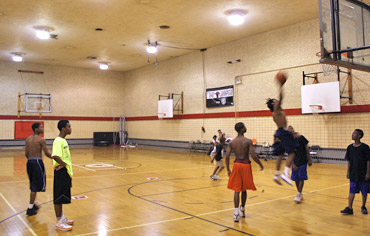
The funny thing about Jordan ballin' at Foster Park -- and no one who plays with him there on a regular basis can seem to figure it out either -- is how he hardly ever misses a Saturday or Sunday.
Even when he's "on the road" doing Bobcats stuff or making Brand Jordan appearances or hopping a charter with Charles Oakley to do their thing, he makes it back to the small field house on the South Side to do the two things he does as well as Usain Bolt runs: hoop and talk trash.
You'd think in his retirement years Jordan would spend his time on the links to such a degree that basketball would at this point be obsolete to him. You know, get mellow. Naw, not Mike. He still gives his crew (names withheld for privacy purposes) the business … messed-up index finger and all. Stories of heartbreak and shaken heads creep out of the gym every time he's there.
"So what'd MJ do today?" is the question the outside world still asks one of his victims or teammates.
And all they ever say is, "He's still Mike."
But apparently he doesn't roll up to Foster the way he used to roll up to Hoops Gym back in the day. In those days, MJ was so cold he used to wear Jordans (shoes) a year before they dropped in colors that would never see the streets. But that's not the half of it: He'd drive a Ferrari that would be the same color as his shoes!
That Mike is gone now. He just concentrates on keeping his legacy intact by making sure on most weekends no one inside Foster Park makes a name for themselves at his expense.
-- Scoop Jackson
When the commercial dropped, everyone thought it was one of the coldest ever to hit the Jordan roster. You remember the one: He walks into the building speaking about how often he has failed. It was so different from the Mike and Spike joints. So not light-hearted, so not funny. It was Mike in all seriousness.
It gave us -- the viewers -- the feeling of what it felt like and what he was thinking before he went into a game. The trench coat. The walk. Even down to the way he spoke to the security guard. Damn. "Be Like Mike" had just reached a whole new level.
We all believed he was walking into the building where his statue stood. We thought the authenticity of the spot was on point like Zeke in his prime. But the geniuses at Widen and Kennedy had something else in mind. See what we -- again, the viewers -- forgot to remember is just how "large" Jordan really was. The United Center might have been a big enough stage for Jordan to perform, but a Jordan "production" needed much more room. Hell, he'd starred in a movie with Bugs Bunny, dude needed space.
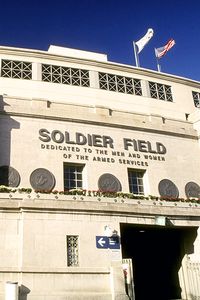
So they shot the spot in the one spot in Chi large and legendary enough to tell a part of Jordan's story yet untold: Soldier Field. If anything in Chicago was larger in presence than Him, the home of the Bears was one of them. (The home of the Cubs would be the other.) The iconic meeting became as memorable as Bruce Lee's visit to the Colosseum in Rome. And all MJ did was walk in. That's all he had to do. And even though we didn't know it, the building he entered did all the rest.
-- Scoop Jackson
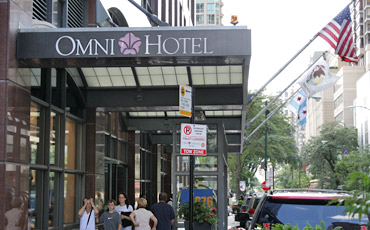
The business of Michael Jordan was not always done at the United Center.
Inside the Omni Hotel, he put work in. He came in suits, sometimes sweats. But his mood was always Trump when he came into his office. The central location was perfect, even though you would never think that Michael Jordan would have his office inside of a hotel. And that was the brilliance of it, of him. He figured if the 777 building across the street was good enough for Oprah to live in, then office space inside the Omni was good enough for him.
For years I never understood why MJ -- with the richness of prime space available in the business district, his ability to afford an entire floor at the Ritz-Carlton to use as an office and with other buildings (Lake Point Tower, the John Hancock, etc.) overlooking Lake Michigan with views that would leave most visitors breathless -- chose a place as casual as the Omni to rent office space.
Until one day, I was boarding a plane and Mike's agent, David Falk, happened to be on the same flight. When they called first-class passengers (which I happened to be on that particular flight), I figured Falk would be getting on with me. He didn't. Instead, he got on after me and walked past me to his seat: 22C. That's when I got it. That's when Michael Jordan's having his office inside the Omni Hotel made perfect sense.
Keep it simple.
-- Scoop Jackson
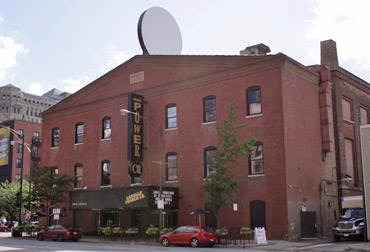
The mid-1990s saw the peak of Michael Jordan's popularity in Chicago and at no address was that more evident than 500 N. LaSalle, the home of Michael Jordan's Restaurant. Here, fans would wait hours for the opportunity to eat uninspiring bar food with the hope that maybe -- just maybe -- they could catch a glimpse of the man himself.
For any out-of-towner, a meal at Jordan's was right up there with a trip to the top of the Sears Tower. It was the place Bulls fans would flock to celebrate another NBA championship and the place where they would lay flowers when James Jordan was found dead in 1993.
Jordan was not an owner of the restaurant, but allowed his name to be used in exchange for royalties. But by 1999, the restaurant was bankrupt, Jordan was fighting its owners in court and there were plans to rebrand the 18,000-square foot facility, "Sammy Sosa's." At a liquidation event a year later, Michael Jordan's Restaurant T-shirts that once sold for $20 in the souvenir shop were auctioned off for 80 cents. Today they can be bought on eBay for a few dollars.
What went wrong? Owners Gene and Joseph Silverberg argued that Jordan's star power diminished. They also criticized Jordan for not visiting the restaurant often enough. In court, agent David Falk testified that Jordan's name was still "magic in a bottle" and all potential business partners were still warned, "Ask not what Michael Jordan can do for you, but what you can do for Michael Jordan."
In June of 2000, a federal judge sided with Jordan, throwing out the contract that allowed the Silverbergs to operate a restaurant in Chicago with the Michael Jordan name attached. Today, there are three restaurants in the country with Jordan's name: A steakhouse at Grand Central Station in New York, and two establishments at the Mohegan Sun Casino in Connecticut.
Meanwhile, in the decade since the original Michael Jordan's closed, 500 N. LaSalle has housed a seafood restaurant, a Mexican restaurant and, most recently, LaSalle Power Co., a rock-n-roll inspired restaurant, bar and music venue.
Editor's note: Since this piece was published, Jordan opened "Michael Jordan's Steakhouse" on Michigan Ave. in Chicago.
-- Wayne Drehs
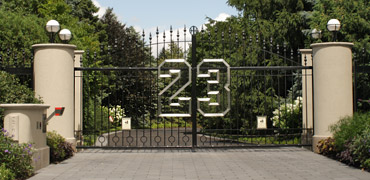
Though many in the city consider the United Center the house that Jordan built, the property that actually describes sits on eight tree-filled acres in the northern suburb of Highland Park.
There, behind an iron gate with the number "23" on the front, is Jordan's 27,648-square-foot home. It's a structure with 12 full bathrooms, 5 half-bathrooms, a 7,300-square-foot basement and a 4,200-square-foot garage. The home features a movie theater, a basketball court, a tennis court, an indoor/outdoor swimming pool, a Jacuzzi, a sauna and, outside, a putting green.
The home was built in 1994 and, according to Lake County records, the taxes alone run $150,000 per year. Though Jordan and his former wife Juanita divorced in 2006, Jordan is still believed to call the residence home.
Editor's note: Since this piece was published, Jordan has put this house up for sale.
-- Wayne Drehs
It was 1990, three years before Michael Jordan would retire from basketball to make a go of becoming a professional baseball player, when he asked Bulls and White Sox chairman Jerry Reinsdorf for a favor of sorts.
"All he wanted to do was take batting practice with the White Sox," said Jeff Torborg, the White Sox manager at the time. "So Jerry called me and said, '[Hitting coach] Walt Hriniak won't work with him.' Walt said, 'He's not part of our team.' Jerry said to me, 'I just don't want Michael to be embarrassed.'
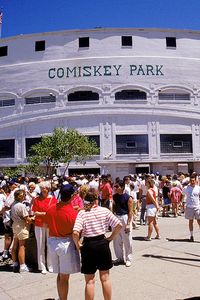
"I said to Jerry, 'How am I going to help him? Have you ever seen me hit?' But I took him to the batting cage with my middle son, Greg, who was a college player and a bullpen catcher for me while he was waiting to go to law school, and had him pitch to Michael."
In the dusty room on the second floor of the old ballpark, the first few pitches were, well, not good.
"He couldn't hit anything; he just kept swinging and missing," Reinsdorf said.
"We worked on some flips," Torborg said, "and Michael was pulling off the ball a little bit. He was a great athlete, obviously, and I said, 'You're a golfer. And you have pictures taken of you all the time with automatic cameras. Think of what you do in golf -- keep your head down, and keep it down for three of four clicks of an automatic camera.'
"It was amazing. He made the proper adjustment in one swing and started hitting bullets."
They left the cage and went to the field, where the White Sox players were scattered mostly around the outfield for batting practice. They jogged in and lined the infield, laughing with and at Jordan. No way was he going to hit it past them.
"Walt was not going to let him hit," Torborg said. "I said, 'OK, batting practice is over then. Michael is only going to hit for the last five minutes.'"
Hriniak stalked off, and Jordan stood at the plate, the Sox players laughing and teasing the newcomer.
With coach Dave LaRoche pitching to him, Jordan dug in. His first few swings went for ground balls.
"And then Michael took him to the upper deck," Torborg said laughing, 19 years later. "The great athlete in him, the pride, came out. He crushed that ball."
"Left field," Reinsdorf said, seemingly picturing the moment. "It bounced off the facade of the upper deck."
"And he hit more than one ball out," Torborg said. "He hit two or three real good ones. But that bomb into the upper deck? That was a blast. All our guys ringing the infield were like, 'Whoooa.'
"They got all excited. It was a fun thing. I laughed and laughed. But it was a big deal.
"He was in his 30s when he tried to play another professional sport. He hadn't picked up a bat since he was a kid. But I was impressed with what I saw. I really believe if Michael had played from the time he was young that he would've been a pretty good player."
-- Melissa Isaacson
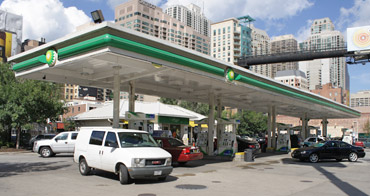
The first thing they all noticed was not the shoes but the bike. But they would notice the shoes, too. All wrong. Nikes, to match his nylon warm-ups. And then they knew, of course.
"There were reports around the local bike hangout spots that Michael Jordan was out riding around that day," recalled Noble Williams, a motorcycle enthusiast and Chicago policeman who was off duty at the time. "When he pulled up, we knew it was him. There aren't too many people riding Ducatis around."
This was the summer of 2003 and into the BP station at the corner of LaSalle and Ontario, across from the Rock 'n' Roll McDonald's, rolled the future Hall of Famer, fresh off the final game of his NBA career and accompanied by his two nephews.
Atop one of the most expensive and powerful motorcycles allowed on the street, Jordan looked like a kid walking onto the playground in short shorts and white kneesocks. Williams and his pals held back the taunts and instead issued a little advice.
"He had a helmet on, which was good," said Williams. "But he needed some padding on him. Thank God he didn't hit the ground. I walked over to him and said, 'You're doing this all wrong.' He gave me one of those looks like, 'Who is this guy?' I said, 'You need to wear jeans out here and you need a jacket and gloves and some boots.'
"Then I gave him my card and said, 'If you want to ride tomorrow, we'll ride, but you need to get the proper equipment.'"
Jordan was nothing if not an attentive pupil. "He called the next day and had all the stuff we recommended him getting," Williams said.
Jordan had ridden dirt bikes with his brothers on the hills around their Wilmington, N.C., home growing up, and he had missed it.
"He told us there were a lot of things he couldn't do because of who he is and contract obligations and various other things," Williams said. "This was something he always wanted to do and now he wasn't committed to anything or anyone."
Their preferred time to ride was 3 a.m., when there was less traffic and less attention. They would travel along Lake Shore Drive, the Kennedy and I-57, Williams and his pals giving Jordan a short course on the fundamentals of riding.
"How to brake, how to downshift without overcompensating with your brakes and getting yourself thrown off the motorcycle," Williams recalled. "We did it all. And thank God, we were usually successful."
Usually?
"There was one time he was learning how to pop a wheelie on a dead-end street and he was picking up the front end and putting it down," Williams said. "He was getting good at it, I guess too good at it because he got overexcited, pulled the throttle, revved the bike and fell off. Landed straight on his butt. But he gets up laughing, 'Oooh.' He ripped his jeans a little, but that's just something that happens."
They would meet at designated spots, usually in front of the Chinese Consulate on Erie and Clark.
"But then as soon as we made that our normal meeting spot, people saw us and by word of mouth, others found out and soon people would be sitting out there all day and all night waiting for him to show up," Williams said. "Our group started out at about seven to 12 people and that turned into 100-plus a night.
"It looked like a motorcycle convention, sport bikes up and down the street, people sitting in their cars. It was funny after awhile but way, way too many people. So we had to scratch that spot off our list and find another place to meet."
Within two years, Jordan would have a Suzuki team in the American Motorcycle Association, and he remains pals with Williams and others he met at the BP that day.
"We threw him right in the deep end right away," Williams said. "And he showed the respect he had for us like we had for him. I guess that's the reason he chose to hang out with us like he did. He knows who authentic people are. If he dropped his bike, we'd look at him like, 'Pick it up yourself.' He was one of us and to this day, that's the relationship we have."
-- Melissa IsaacsonBulls practices during the Michael Jordan era were always lively and rarely uneventful.
Often, Bulls coach Doug Collins and later, Phil Jackson, would stack the teams unfairly on purpose, putting Jordan on the team with all the nonstarters.
"You had to because he was so dominant, especially in the early days, but whatever team you put him on was going to win," Collins said.
But one day the two disagreed on the score, and Jordan stormed out.
"He thought I was doing some Chicago politics to control things, he was in a cranky mood that day and he said, 'I'm outta here, I've had enough cheating on scores,'" Collins recalled. "Once he left there was such a hush in the gym, the guys were looking at me like, 'What's he going to do now?'
"But I didn't do anything because I knew Michael. I knew his background, the family he came from, Dean Smith's system, and I knew he was going to come back the next day and be better."
The next day, beat reporters asked Collins whether he and Jordan had spoken yet.
"I said, 'We don't have to, everything is great," Collins said. "Michael and I love each other. Michael was walking out right as I said that, and I said, 'Show 'em Michael, give me a kiss,' and I think he gave me a kiss on the cheek, and that was the end of it. But Michael knew after that what a barometer he was for any success our team was going to have."
Jordan loved to practice, but that did not mean he always was fun to be around. When he lost, he'd say "Run it back," meaning, "Let's play again and keep playing until it ends the way I want it to end." He also provoked and bullied when he had to and got into a few notable fights, such as one with the bigger Will Perdue and another with the smaller Steve Kerr.
"I realized as I got older and had practiced with him more and more that he would start talking," Perdue said. "If he was tired and didn't feel real good or have his A-game that day, he'd walk in the building talking trash. … And if he came in the locker room talking trash, you knew he was getting himself motivated. He was usually in a good mood, [saying] 'Hey, how are you, let's get going.' But if he came in tired, you would know because he'd be talking himself into it, working himself up. He'd want you to respond. But the older guys, we all learned to just stay away. To ignore him. … If you say something, that's a big mistake. And you would just hope he wouldn't respond."
John Paxson remembers being angry enough with Jordan to perhaps want to tackle him after one notable incident in the mid-'80s.
"Doug told us one thing he'd like to do after our first practice was a mile run, just as a gauge of conditioning but also something to challenge us and see what we can do," recalled Paxson, later the Bulls' general manager and now vice president of operations.
"I always tried to come into camp in excellent shape, especially with a new coach. I came in and figured, 'This is my shot to beat Michael at something.' The guards and wings ran together, and the bigs ran separately. What I remember about it is that I got off quickly. We had to run 11 times around the little track at the Multiplex to equal a mile, and I was leading the whole time and thinking as we went into the last lap that I'm going to win, having the inside lap.
"Then, as we turned the very last corner to finish, I felt somebody on my right shoulder, and I kind of knew it was going to be him. What he did, with his strength, he just shouldered into me and edged me off the track to win. He knocked me off stride, and I was done. At the moment, I was upset at myself and all those things, but it's him. He had to win."
To Jordan, practice was a wonderful place to experiment without limitations.
"I remember we had lost two of three at home to Phoenix [in the 1993 NBA Finals] after winning the first two games in Phoenix," former Bulls point guard B.J. Armstrong said. "And we felt down that we had a chance to close it out but had to go back to Phoenix. We felt especially bad about a triple-overtime loss in Game 3.
"But we had played hard, and I remember him saying [about the triple-OT game], 'We didn't lose, we just ran out of time.' And I was kind of like, 'Yeah, right, time ran out.' It was a different way of looking at it. And he said, 'That's why I love practice, because there is no time.' It was an interesting perspective."
Practice, Armstrong said, afforded a glimpse at Jordan unlike anything the rest of the world saw.
"He was like an artist, out of time, out of the box," Armstrong said. "From the moment I met him, I always said it was a shame the public couldn't see him practice because games really confined him. He couldn't fully explore his imagination."
"Practice was him, the very best of him."
-- Melissa Isaacson
Two days earlier they thought they were going to die.
The Bulls were on their way back from Philadelphia on Saturday night, March 4, 1995, following a victory over the 76ers that still had Chicago languishing at one game under .500 and Phil Jackson still searching for his team's identity. It was the Bulls' second season without Michael Jordan following his retirement from basketball. And if these weren't the dog days, they were a pretty good facsimile.
On the flight home the cabin lost pressurization, and within seconds, the plane dropped from 35,000 feet to 10,000 feet, sending dinner trays flying and oxygen masks dropping from overhead.
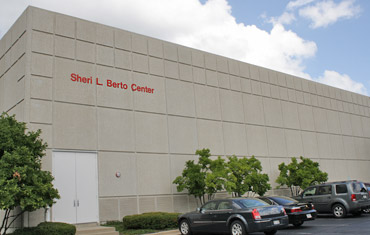
The plane ended up landing safely, and after a day off, Tom Smithburg, the Bulls' young public relations assistant in his first year on the job, showed up for work at the Berto Center expecting another ordinary practice in an ordinary season.
"Walking through the doors, I didn't see the court yet but I could immediately sense something was different," Smithburg said. "It was the noise of players playing, but everything was louder and faster, and I walked into the trainers' room and [trainer] Chip Schaefer and [equipment manager] Johnny Ligmanowski looked like they had seen a ghost. I asked what was going on but nobody spoke.
"So I walked out to the floor and who was out there, dunking on his former teammates in Bulls shorts and T-shirts, but Michael."
Smithburg, now the principal partner of Chicago-based TeamWorks Media, still remembers it vividly.
"It was just another day in March," he said. "You know we're barely going to make it to the first round and we're not going to make it to the second. There's the awful plane trip. The franchise was still highly regarded, but right at that time the Bulls were ready to fade away.
"And then there was this moment when everything changed. From that point to four years forward, the entire franchise changed. The energy level, the mood, that day Michael walked in, the difference was palpable."
Phil Jackson said he had known for "a little while" that Jordan was going to practice and "see where he was at." But the players did not know.
"So it was very dramatic," Jackson said. "I don't know if we had two or three guys at that point [Scottie Pippen, B.J. Armstrong and Will Perdue] who had played with Michael and were comfortable with how he played and practiced. With all the rest of the guys, like Toni Kukoc and Steve Kerr, it was a whole new thing."
For Kerr, the moment was "surreal. For a second, everyone was in shock."
"There were a couple rumors that he was thinking of coming back and we definitely talked about the rumors, but there was no forewarning that anything was happening," Kerr said. "I don't remember Phil saying much.
"We were pretty much dead at that point and that was the ultimate pick-me-up. With Michael, anything was possible."
Like 55 points against the Knicks at Madison Square Garden in his fifth game back, after eight practices. But not, as some zealously predicted, another Bulls championship: They lost in six games to Orlando in the Eastern Conference semifinals.
That summer, Jordan filmed "Space Jam," in which there were pickup games on a makeshift court built on the set. "And then he came to camp and it was on," Kerr said. "You could just feel the intensity. It was all-out competition and emotion."
During one scrimmage, it got a little too emotional.
"The bench guys were practicing against the starters and they were burying us and Michael was talking trash," Kerr said. "It was clearly like a pack mentality. He was the leader and he was letting everyone know who was boss. I had no problem acknowledging he was the leader. That was obvious. But I think maybe in my mind he crossed the line, and I thought I could stand up for myself.
"The play got more physical, he was talking trash, and next thing I knew, we got tangled up. In a way, it was kind of a rite of passage that he was going to challenge you to see how you were going to respond."
Kerr ended up with a black eye and their teammates had to pull the team apart.
"Obviously, he could have killed me," Kerr said in reference to the three inches and 35 pounds Jordan had on him. "It was a crazy scene. I left practice. But by the time I got home, he had already left a message saying he felt badly.
"Our relationship after that was great. I think I earned his respect, which may sound strange, but who's to argue with his methods? I'm wearing three championship rings on my fingers as a result."
-- Melissa Isaacson
What would happen if there were no crowds? No cheers? Just a gym and a basketball and the best basketball players in the world?
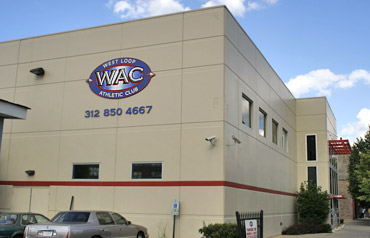
Michael Jordan knew. On any given summer day during the latter half of his career, he could be found playing in games worthy of NBA All-Star billing at Hoops the Gym under the guidance of his personal trainer, Tim Grover. Grover's client list, which started with Chicago athletes and soon grew, helped fill out the rosters.
"We'd have them on a regular basis," said Grover of games that could hardly be called pickup, what with scorekeepers, trainers and NBA refs like Danny Crawford, Ron Olesiak, Marc Davis and James Capers, sometimes just coming off the NBA Finals themselves.
"We'd have Kobe Bryant, Paul Pierce, Dwyane Wade, Ron Artest, Charles Oakley, Antoine Walker, Juwan Howard, Michael Finley, Ray Allen, Penny Hardaway, Quentin Richardson, Darius Miles, Shawn Marion, Kobe Bryant and Chris Paul and on and on. I couldn't even tell you how long the list was."
Once, they even allowed a promising high school player from Ohio named LeBron James in the gym.
"We let him play," said Grover. "We could tell he was going to be special."
"We let him play one game," confirmed Jordan's close friend and one-time Bulls teammate Charles Oakley of James. "Mostly, he sat and watched."
The games were part of Grover's training program and they were a far cry from H-O-R-S-E or even regular-season NBA games, according to Grover.
"They were more intense because all the guys were either starters or top-seven players," he said. "And guys didn't have to worry about saying something or doing something that would get out to the media. And back then it was a lot easier to monitor because there were no frigging camera phones."
Were there fights?
"All the time," Grover laughed.
And Jordan usually had something, either directly or indirectly, to do with it.
"His trash-talking was legendary," Grover said. "It started before he walked into the gym."
--Melissa Isaacson
Oprah Winfrey was barely known outside of Chicago when Michael Jordan was exercising influence the future media mogul would have envied.
Even at the end of his Bulls career in Chicago, Jordan could still point his finger and work civic wonders.
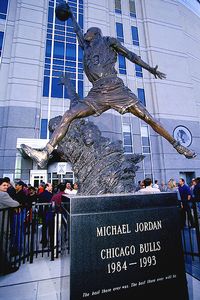
Before a Bulls game in February of 1998, Chicago Marathon executive director Carey Pinkowski asked his friend, marathon runner and Bulls assistant public relations director Tom Smithburg, if there was any chance Jordan would meet defending marathon champion Khalid Khannouchi, who followed the Bulls while growing up in Morocco.
The Chicago Marathon desperately wanted Khannouchi to return to the event in 1998 and attempt to break the world record.
Smithburg did not have high hopes of getting Jordan to fulfill still another of the dozens of daily requests, but asked anyway, mentioning that Khannouchi ran the 26-plus miles in 2:07.
"Come on," Jordan said, "Two hours? Go get the runner."
Khannouchi had no idea he was going to meet Jordan and was visibly trembling when he saw the Bulls' star. Jordan shook his hand and said, "I hear you're running marathons in under two hours, 10 minutes."
Then he pointed at the diminutive runner more than a foot shorter than him and told him, "Now you're going to have to come back to Chicago and break the world record."
Within a week, the news that Khannouchi was returning to the Chicago Marathon was made public. He would compete in the race five more times, winning it three more times and breaking the world record in 1999, finishing in 2:05.42.
-- Melissa Isaacson
Gate 3½ of Chicago Stadium sounded like a mistake, looked like a mistake. And yet, it was a magical portal through which passed the subculture and the stars -- TV cameras and circus clowns, cheerleaders and yellow-jacketed ushers and 7-foot men colliding on any given night.
Except for Michael Jordan.
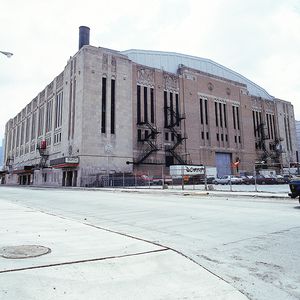
When Jordan arrived at Gate 3½ for Bulls games, it was often hours before anyone else arrived.
"The sun wasn't even down yet and he would arrive alone and go into the stadium with one or two ball boys who came early because they knew he was there," said Bob Greene, then a syndicated columnist for the Chicago Tribune and author of "Hang Time: Days and Dreams with Michael Jordan" and "Rebound: The Odyssey of Michael Jordan."
Greene enjoyed access to Jordan while he was writing his books that few other reporters enjoyed.
"Sometimes, he'd shoot by himself, in his light-blue Carolina shorts, in the darkened stadium for an hour or so," Greene said. "It was sort of his private warm-up time. It was so empty the ball would echo in a different way.
"I'd always contrast that to the sound of the roar three, four hours later when the announcer would say, 'From North Carolina …' What those people never saw was the guy working by himself, not only to get better but in a weird way, not to get any worse and let somebody surpass him."
-- Melissa Isaacson
They were the last ones out of Angel Guardian Gym one night in 1984 when Bulls rookie Michael Jordan and teammate Rod Higgins became immediately alarmed when leaving what was then the team's practice facility.
"We heard a dog's bark, a big dog's bark," said Higgins, now the GM of the Charlotte Bobcats. "It was really dark, so we couldn't see anything. And out of nowhere, this huge, I think, German shepherd, starts to come at us. Michael sees it first and bumps me out of the way with his elbow as we both start running.
"We start circling my car, trying to get away from it, and then Michael jumps on top of my hood. Then I had to do the same because the dog was ready for blood."
Twenty-five years later, Higgins groaned a little.
"I had an '82 BMW and, oh man, the hood was all dented. We nicknamed the dog, we were so scared. But we never saw it again. And I never let Michael forget that he elbowed me. Basically he was telling me, 'You're on your own. I can handle basketball, but I don't handle growling German Shepherds.'"
-- Melissa Isaacson
They congregate down there in the winter because the heating ducts make it a little more bearable. Same with the air-conditioning ducts in the summer.
There on Lower Wacker Drive, the homeless form makeshift communities, the size of which depends largely on the weather.
Michael Jordan hated the cold. Growing up in Wilmington, N.C., where the high temps in the winter months were still near 60 degrees and the lows rarely dipping below the 30s, Chicago was a shock.
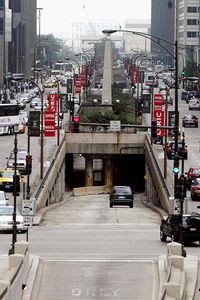
One winter in the late '80s, as another severe cold front swept through with temperatures dipping to 10-below and wind chills down to 20-below, Jordan watched the forecast on television and told his friend and then-driver George Koehler they had to do something.
"It got done so quickly, I don't know how he did it," Koehler recalled. "Michael had coats and stuff at his house, but it wasn't enough. So he contacted some of his endorsement people like Nike, Hanes and Gatorade and put together little care packages -- soap, toothbrushes and toothpaste, socks, scarves, gloves, long underwear, sleeping blankets, snacks and drinks, all in Nike backpacks. He got a couple of vans, a few friends and we drove up and down the streets all night, giving stuff out to anybody in the streets who needed it."
It hardly mattered that he was Michael Jordan, Bulls superstar.
"At first, a lot of people didn't know it even was Michael because he was bundled up like an Eskimo. They just said 'thank you,' and he told them he had been thinking about them."
-- Melissa Isaacson
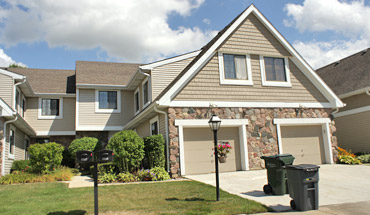
On the day that he walked into Michael Jordan's townhouse for the most important job interview of his life, Tim Grover had more on his mind than the type of shoes he had his feet.
He had 90 minutes. Ninety minutes to convince one of the most physically gifted athletes in the world that it was he -- the former Division I basketball player at Illinois-Chicago, the guy who was four years removed from earning his master's degree in exercise science -- who could reshape Jordan's body and help take his game to the next level.
"He told me he would try it for 30 days," Grover said of that afternoon in 1989. "Well, 30 days turned into 15 years."
Much to the chagrin of the Bulls, who were leery of an outsider working with their most prized possession, Grover became MJ's personal trainer. In a tiny corner of Jordan's basement, he would push MJ to his physical limit and in doing so became one of the key behind-the-scenes pieces to the success of both Jordan and the Bulls. He would be there in the early mornings when Scottie Pippen, Ron Harper, Randy Brown and others would join Jordan for their "Breakfast Club" workouts. He'd watch in amazement as Jordan would shoulder press an eye-opening 245 pounds. He'd train Jordan to get past the Detroit Pistons, play professional baseball, return to basketball and then return to basketball yet again.
While Jordan would go on to win six championships and become arguably the greatest player in NBA history, Grover would create Attack Athletics, one of the premier athletics training companies in the world. Grover's roster of clients now includes everyone from Kobe Bryant and Dwyane Wade to Alex Rodriguez and Donovan McNabb.
And it all started with that meeting, with those 90 minutes of Grover's convincing Jordan he could do the job, despite the fact that he wore Converse sneakers to Mr. Nike's home.
"He told me, 'when you come back, you better make sure you don't have Converse on your feet,'" Grover said. "I never made that mistake again."
-- Wayne Drehs
Jerry Reinsdorf knew, of course. And Jerry Krause. Phil Jackson, too. Scottie Pippen said he was "kind of" told the night before, but he didn't really believe it.
But it wasn't until the news flashed around the new Comiskey Park the way an electric shock passes from hand to hand that the rest of Chicago and beyond heard for the first time that Michael Jordan was retiring from basketball at age 30.
Jordan was to throw out the first pitch of Game 1 of the American League Championship Series between the White Sox and Toronto Blue Jays on Tuesday night of Oct. 5.
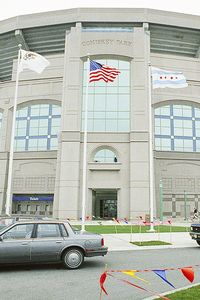
It had already been quite a day.
Jordan had spent the afternoon breaking the news to Bulls coach Phil Jackson and general manager Jerry Krause. Jackson tried to talk him out of it, and when Jordan said he had made up his mind, Jackson teared up.
"I hated it," Jordan said in an interview in Birmingham where he was playing minor league baseball a year later. "It was so tough. I had never seen Phil cry. And he was very genuine about it. I never saw the emotional sides of a lot of the guys until it was time for me to leave."
Reinsdorf had known for sure several days earlier, when David Falk, Jordan's agent, had dropped the bomb over after-dinner drinks at the Jordan Foundation's annual event.
"He said, 'You're not going to believe this but Michael wants to retire," Reinsdorf recalled of Falk's words. "I was stunned, of course. And then he said, 'And he wants to play baseball.'"
On that Tuesday night, several of Jordan's teammates were scattered around the ballpark and in suites as the news spread that there was to be a press conference the next day announcing his retirement.
"I told everyone, 'Let's try to keep this under wraps," Reinsdorf said. "I didn't want to upstage the playoffs. Then I was walking with [NBC executive] Kenny Schanzer [before the game] and he tells me how shocked he was that Michael was retiring. I said, 'How do you know?' By the time we got up to the box for Michael to throw the first pitch, everybody knew. [Television reporter] Jim Gray was trying to knock down my box and Kup [Sun-Times columnist Irv Kupcinet] was in [Sox owner] Eddie [Einhorn's] box and he took advantage of where he was and called in the story.
"I knew Major League Baseball was going to be really upset with me. They were upset anyway that we had Michael throw out the first pitch."
Pippen, peeking his head out of another suite, was also being bombarded by reporters.
"I said I didn't know anything about it, and I really didn't feel I did know for sure," Pippen said in an interview several months later. "I didn't think it was a rumor, but I wanted to hear it from him. So I went back in and called up to his suite and he told me. I was very shocked. Shocked, hurt and surprised."
Another Bulls teammate, Scott Williams, who considered Jordan a close friend and mentor, was in another suite when his publicist called to tell him she heard about Jordan's retirement on TV.
Williams walked onto the balcony of the suite and looked up toward Reinsdorf's box hoping, he said later, that maybe Jordan would lean over, look down and laugh that it was all just a prank.
"It seemed like I stared up there for a long time," said Williams, who eventually took the elevator up and got the news from Jordan himself.
"I had tears in my eyes," Williams said. "As soon as I saw him, I knew it was true. I don't even remember what he said to me. It was all sort of a blur. But I remember him consoling me a lot more than I was consoling him."
Jordan never did see the game.
"We got Michael out of there," Reinsdorf recalled, "through a tunnel and out of the ballpark."
And the White Sox lost 7-3.
-- Melissa Isaacson
The first time Doug Collins ever met Michael Jordan was in a doctor's office, and the conversation was memorable.
It was May 1986, shortly after Collins had been hired to replace Stan Albeck as the Bulls' head coach, and a month after Jordan had dropped 63 on the Celtics in a double-overtime loss in Game 2 of what would be a Boston sweep in the first round of the playoffs.
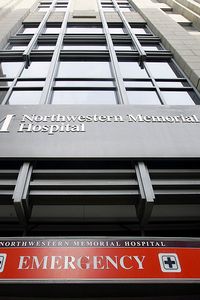
Jordan had missed 64 games that season with a broken foot and was furious when Bulls management tried to hold him back upon his return. His minutes were strictly monitored, to the point where, even in a close game with time running out, Albeck would have to take Jordan out of the game if MJ's allotted time had expired.
Jordan was in team doctor John Hefferon's office following the playoffs when he ran into his new coach. Collins was there to get his knee checked out.
"When Dr. Hefferon showed us [Michael's] X-rays, you could see a shadow where there was still healing going on in the foot," Collins recalled. "I said, 'Michael, I think the doctor would like you to take it easy this summer.'
"I told him, 'I had a similar injury' -- though mine was a stress fracture and his was a break all the way through -- 'and it eventually caused me to hurt my knee.'
"I'll never forget what he said to me," Collins said. "He said, 'That's your foot, it ain't mine. I love to play and I'm going to play.' He told me, 'Always remember something. When you have a thoroughbred, you have to let him run. If you hold him back, eventually he'll stop running.'"
Collins remembered.
-- Melissa Isaacson
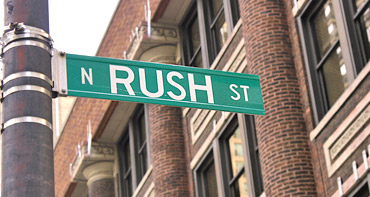
When he first came into the league, Michael Jordan did what he was supposed to do: learn the city. At the time in Chicago, Rush Street was the spot. Clubs, bars, women, velvet ropes and VIP rooms for the superstars. (The block was so hot Rob Lowe and Demi Moore used it as their hook-up destination in "About Last Night.") All the players in the city hung out there: Bears, Cubs, Hawks, White Sox, wannabes. And no one had the Rush Street scene on lock quite like Jordan's then-teammate Quintin Dailey.
"Q" was worldwide before there was a Wes. On the social tip, he was Chicago's most wanted. Public enemy No. 44. Before women began going crazy over Jordan, they were literally throwing themselves at Dailey. It's always been thought that hanging with Dailey during his rookie season prepared Jordan for what his own level of celebrity was about to become. It made him. And with that, Rush Street simply became a microcosm of the rest of the city. Then, soon after, the rest of his world.
-- Scoop Jackson
There wasn't one story or two. Not a handful of children, but hundreds. Hundreds and hundreds of sick and terminally ill kids with one wish -- and that was to meet the greatest basketball player in the world.
It did not come easily to Michael Jordan, though he certainly made it look as if it did.
Once very early in his NBA career, Jordan was taken on a tour of Wyler's Children's Hospital, now the University of Chicago Children's Hospital.
"In the first room was a 12-year-old boy who had been hit by a car on his bicycle," recalled Jordan's friend and then-driver George Koehler. "He was unconscious and unresponsive, but his eyes were wide open. The parents were both there, crying, and Michael introduced himself.
"He was 22, 23, just a kid himself, and he walks over to the bed, takes the kid's hand and starts rubbing his arm. He tells the boy, 'You'll be fine. Take a little nap now, but when you wake up, your parents are here waiting for you.'"
They would visit at least 15 rooms that day, each with a child whose circumstances seemed more tragic than the last, until the group moved onto a room with a little girl jumping on her bed.
"She was in a little dress, with black patent leather shoes and frilly socks," Koehler recalled. "The nurse said, 'Michael, this is Jennifer. She's going home today. She's just waiting for her parents.'
"Michael and I looked at each other like, 'Finally, some good news,' and Michael held hands with her while she jumped up and down, and colored with her.
"When we walked into the hall, I said to the nurse, 'That's great news. What was wrong with Jennifer?' And she turned to us and said, 'Jennifer has leukemia; she's going home to die.'"
Afraid he was going to lose his composure, Koehler excused himself and told Jordan he would meet him outside.
"I'll never forget it," Koehler said. "He grabbed my forearm and squeezed so tight I thought he was going to break it. And he said, 'I need you to help get me through this. If you help me, I'll help you.'"
Because Jordan could not visit every hospital, the kids started to come to him. For years, he would host children at his restaurants from the Make-A-Wish and Starlight Foundations, both of which help terminally ill kids get their last wishes. Twenty families at a time would come to his establishments, where he would be able to visit all night, going from table to table.
But most of his visits came at the arena, in Chicago and on the road, sometimes two and three times a week.
Once, at Chicago Stadium, former Bulls assistant coach Johnny Bach remembers the visit of a young boy who had been horribly burned by acid at the hands of an abusive father.
"Michael brought him into the locker room and treated him like a prince, talking to him and taking him on the court," Bach said. "Johnny Pax [Paxson] and I looked at the boy and couldn't hold back the tears."
Out on the court, Jordan had the boy dribbling and rebounding, and as the game was about to begin he gave him a seat on the Bulls' bench next to his own.
"And a ref who shall remain nameless," Bach recalled, "said, 'Michael, you can't put him on the bench.' Michael replied, 'Try not having a game then.' And that boy stayed on the bench the whole night. And every timeout, Michael would leave the huddle and listen to him and ask, 'How's my jump shot?'
"It was the most touching scene I'd ever witnessed, and people will never know how many times he did this."
A few years later another child would come to visit Jordan at Chicago Stadium. He was a 9-year-old boy named Cornelius Abraham.
Cornelius and his little brother Lattie McGee, 4, had been tortured by the boys' mother and boyfriend. Lattie died after months of being beaten, starved and left hanging in a hot closet.
Cornelius somehow survived the brutality, and three years later -- after then-Chicago Tribune columnist Bob Greene had chronicled the horrific events and helped get the mother and boyfriend sentenced to life in prison -- the Bulls invited Cornelius to a game.
What Cornelius did not know was that Jordan had read Greene's columns, had heard Cornelius was coming and volunteered to meet the boy.
"He walked up and said, 'Hi, Cornelius, I'm Michael Jordan,'" Greene remembered. "It would be just as easy to say, 'Hi, young man, what's your name?' But at the same time the kid is saying to himself, 'I can't believe I'm with Michael Jordan,' he knew [his] name. It was a small thing, but he always knew kids' names because he knew they could get nervous. Cornelius could barely open his mouth."
Cornelius sat on the bench, too. In Michael's seat, saving it for him. And when Michael came off the court, Cornelius sat on the floor right next to him.
"Nothing could bring Lattie back," Greene wrote in his book, "Hang Time," "and nothing could undo what had been done to Cornelius. But the killers were in prison, and Cornelius was in the Stadium, sitting on the wooden surface of the court, right next to Michael Jordan's chair. At one point late in the game, Jordan took a pass and sailed into the air and slammed home a basket. And there, just a few feet away, was Cornelius Abraham, laughing out loud with joy."
-- Melissa Isaacson

O'Hare International Airport
George Koehler was cussing to himself.
It was late September in 1984 and Koehler, who owned a limousine service, was at his usual post at O'Hare Airport, holding up a sign for a customer. But as the flight emptied, no one approached him.
"I had just spent 45 minutes parking the car, not to mention paying for parking," Koehler recalled. "Finally, the pilots got off the plane and I asked one of them if there was anyone else aboard and he said, 'Just one more guy. He'll be off in a minute.'
"I waited a few more minutes and then down the tunnel walks Michael."
A Bulls fan, Koehler, then 29 years old, recognized the skinny 21-year-old top draft pick from North Carolina who had lagged behind to sign autographs for the flight crew. Well, almost recognized him.
"I was excited because I knew who he was and I thought, 'Holy smokes, it's Larry Jordan,' " Koehler said. "I played four years in high school with a guy named Larry Jordan so that name was stuck in my memory bank.
When I saw Michael, I said, 'Larry Jordan.'
"He turned to me and said, 'How do you know my brother?' Obviously, I didn't know he had any siblings, much less one named Larry."
Once they cleared that up, Jordan told Koehler he was going to look for a taxi.
"I just wanted to pay for my parking," Koehler said, "so I said, 'I have a limo. I'll take you anywhere you want to go for 25 bucks.' "
Koehler sensed that his passenger was a little uneasy. "I looked in the rearview mirror and I couldn't even see him because he was scrunched down like a little kid," he remembered. "I don't know if he'd been in a stretch limo before; he didn't know anyone in Chicago, I was a stranger and he was obviously a bit nervous that I could drop him off in an alley somewhere."
Instead, Koehler dropped him off at his destination, the famous purple Lincolnwood Hyatt House, not far from where the Bulls practiced at Angel Guardian Gym. Jordan gave him 50 dollars and told him to keep the change, and Koehler gave him his card.
"I told him, 'If you need to know of any places to live, restaurants to eat, you want to go out for a beer, you've got a friend in Chicago. And oh, by the way, congratulations on your gold medal.'"
Two weeks later, Koehler's phone rang.
"I heard, "Georgie, my boy,'" Koehler recalled. "I'm going, 'Who's this?' and he says, 'It's MJ.' I said, 'I don't know any MJ.' And he says, 'Yes, you do.' And I'm like, 'I'm not going to argue, I don't know who this is."
"And he's like, "Dumb [expletive delete], it's Michael Jordan.' I could hear him grinning."
Jordan asked Koehler to pick his parents up from the airport the next day for his first game and the two struck a handshake deal with Koehler taking him back and forth to O'Hare for road trips all season, after which they would return to Jordan's townhouse in Northbrook, where they would spend hours talking.
"We became friends that way," Koehler said. "And 25 years later I don't drive the limo for him, but we're still really close friends. I've met just about everyone under the sun through Michael. If you picked up a book about Michael's life, it would be my life, just Michael's name on the cover. I don't know if you believe in fate, but I obviously do. My whole life could've been different if my customer had showed up that day.
"Michael likes to tell the story and say, 'George was the first person I ever met in Chicago. He gave me a ride and has taken me for a ride ever since.'"
-- Melissa Isaacson

Comments
You must be signed in to post a comment