
Editor's note: An earlier version of this story ran on June 19 during the World Cup group stages.
At the 2026 FIFA World Cup, researcher William Peracchio had been keeping a keener eye on the scoreboards than most.
He's not a soccer fan by nature. Sure, he tunes into the World Cup every four years, but he's got enough on his plate working in tech at the Massachusetts Institute of Technology, or getting his masters degree in public administration at both Harvard and Stamford.
Still, he has been watching this World Cup, and he was most excited for a "Scorigami."
A Scorigami is a unique scoreline. The term was coined in 2014 by sportswriter Jon Bois, who recognized scorelines that had never taken place in the NFL. There were, as you would expect, plenty that still hadn't happened. (There hadn't, for example, ever been a 15-8 victory, or 25-18.)
"Scoragami is a word I just invented, and it refers to the act, and art, of producing a final score in a football game that has never happened before," Bois wrote.
The Scorigami principle was later applied to other sports. Did you know there still hasn't been a 138-102 victory in the NBA? And in Major League Baseball, there has never been a 22-0 victory, but there have been two different 23-0 games?
The same Scorigami concept can be applied to this World Cup, and it took only four days for one to almost take place, as Germany beat lowly Curaçao 7-1 (no World Cup game has ever had an 8-1 score).
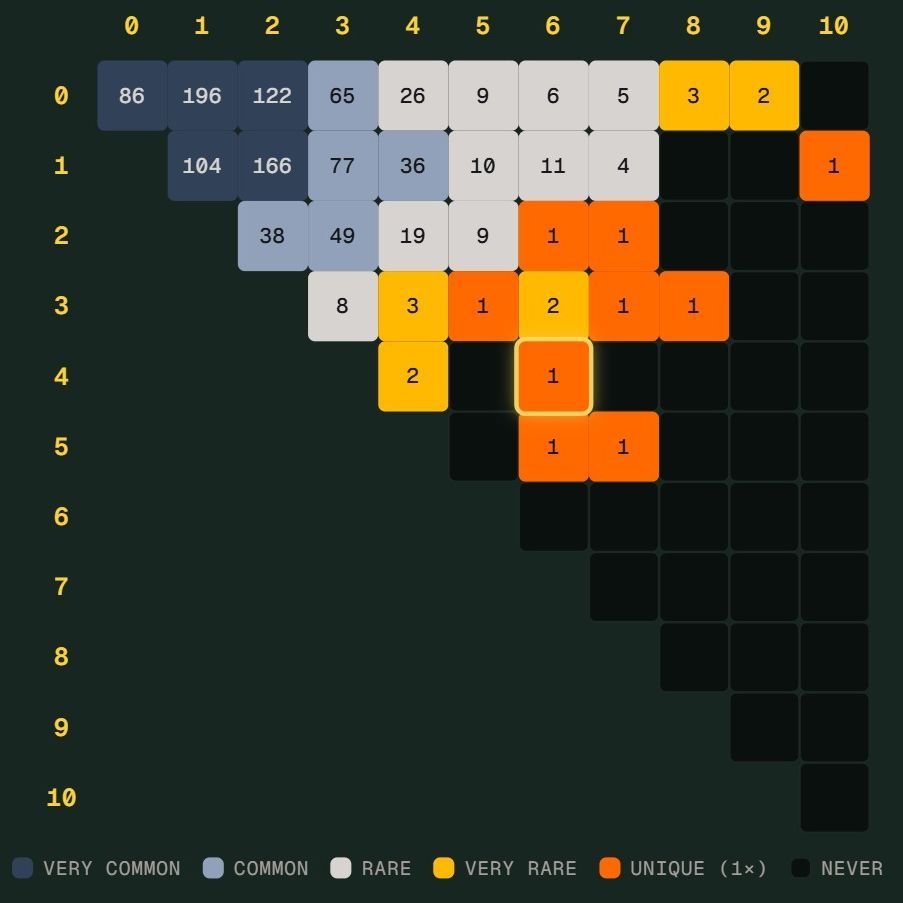
Peracchio should know: Through his love of sports analytics, he has created his own World Cup Scorigami chart -- called World Cupigami.
"This is a fun little project," Peracchio told ESPN before the World Cup. "There were some free data sets online ... I was just like, it'll be fun. And if we happen to get a 5-4 barn-burner? All the better."
Well, in the 103rd (and penultimate) game of the 2026 World Cup, the Scorigami that Peracchio wanted finally happened.
(Credit: William Peracchio, World Cupigami)
How a Scorigami happened
For a Scorigami to happen at this World Cup, it was going to take either a historically lopsided scoreline or an ultra-competitive goal fest. Thankfully, after FIFA's decision to expand the tournament to 48 teams, the chances of one of those two things happening became much higher.
Not all one-sided scorelines would be unique -- 8-3 (Hungary vs. Germany, 1954) and 10-1 (Hungary vs. El Salvador, 1982) have already happened -- so the next most likely Scorigami would probably be a high-scoring end-to-end thriller. There has never been a 5-4 victory, or a 5-5 draw, although there has been a 6-5 (Brazil vs. Poland, 1938) and 7-5 (Austria vs. Switzerland, 1954).
A lopsided scoreline seemed the most likely, with 8-2, 10-0 and 9-1 all potential Scorigamis. Still, after 72 group games, none of them happened. Then, after some more closely contested knockout games, it seemed like this World Cup would pass without a unique scoreline ... until Saturday, when England sunk France in the third-place playoff.
A 6-4 game had never happened at the World Cup until England rebounded from their late semifinal defeat to Argentina with a rapid 4-0 halftime lead, only for France to score three goals by the 66th minute -- including two from Kylian Mbappé.
Bukayo Saka restored England's two-goal lead in the 87th minute to send the score to 5-3, then France's Ousmane Dembélé answered in the 96th minute. A 5-4 England win would have been enough for a Scorigami, but Jude Bellingham's 98th-minute goal gave us a 6-4 Scorigami instead.
Per Peracchio's World Cupigami, it was the World Cup's 34th unique scoreline.
Why you should root for a Scorigami
You would think that Scorigamis happen often. In the NBA, for example, the Indiana Pacers' win over the Chicago Bulls was the first 145-126 victory in league history. There were five Scorigamis in the NFL last season, too. (There were also rare scores, such as 44-22, which had only happened once in NFL history before it occurred twice in three weeks in 2025.)
At the World Cup, though, a Scorigami is much rarer. So rare in fact that it hadn't happened for 40 years until England notched a unique scoreline with a 6-2 win over Iran in 2022. Before that, Hungary's 10-1 demolition of El Salvador in the 1982 group stage was the last time it had happened.
There are no prizes for guessing the most common scoreline. The World Cup is the biggest tournament in soccer and often creates cagey, tense games. So it is no surprise that a 1-0 win is the most common result, occurring 196 times (13 of which at this World Cup). Also, there have been more 2-1s (166 occurrences) than 2-0s (122).
At its heart, a Scorigami is little more than a niche statistic, and barely even a talking point. But it's also a regular cause for celebration. Previous NFL Scorigamis have seen fans raise money for charitable causes, and Peracchio had been hoping a Scorigami at the World Cup would help do the same.
So, in honor of England's 6-4 win over France, he has started a fundraiser for the losing side: He is raising money for a French charity called "Premiers de Cordée" that "provides free sports activities for hospitalized children and young people with disabilities, helping them experience joy, confidence, inclusion, and a welcome break from treatment."
