

WHITE SULPHUR SPRINGS, W.Va. -- You don't have to be a swing guru or a PGA professional to see the renovations that Tiger Woods' swing has undergone since late last year. You do, however, have to be schooled in the nuances of the swing to fully comprehend their subtleties.
Woods employs terms such as "patterns" and "feels" to help explain these changes, but the message often gets lost in translation, just another game of buzzword bingo instead of a clear explanation of the mechanics.
It didn't take a pedigree or trained eye to understand how Woods' swing looked during the first round of the Greenbrier Classic on Thursday.
It was smooth. It was fluid. It was effortless.
It was everything it hadn't been for the first six months of this year.
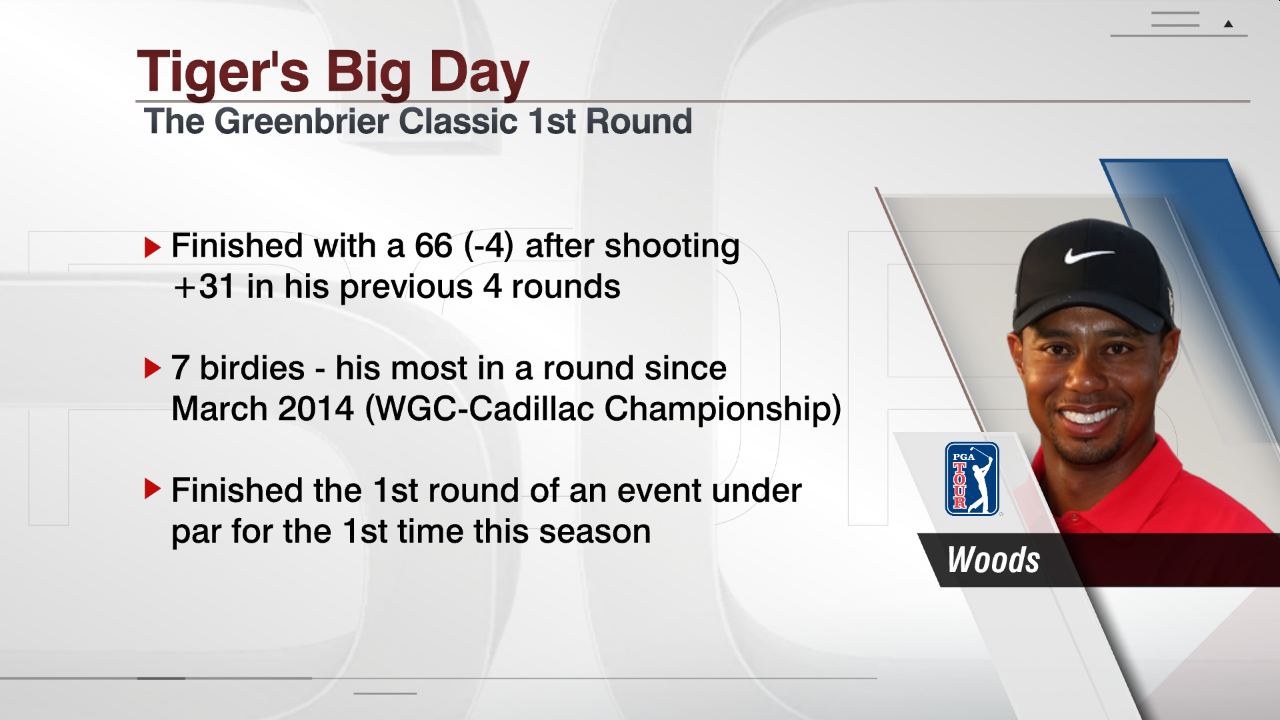
Woods posted an opening-round, 4-under-par 66 that didn't just look pretty on the scorecard. It looked pretty in person, too.
He found 10 of 14 fairways. Hit 15 of 18 greens in regulation. And for the most part, he looked like a golfer who was in control of his swing.
After his round -- his lowest on the PGA Tour since March 2014, and lowest in an opening round since September, 2013 -- Woods wasn't relieved. He wasn't smug. He wasn't overly satisfied. But he did offer a little I-told-you-so to help support his previous claims that he was gradually improving.
"I wasn't that far off," he maintained. "Even though my scores don't indicate it, my swings don't indicate it, but my feels were telling me that I wasn't that far off. I was proving it to myself, time and time again away from a tournament site and on the range, but my feel in my hands and my body weren't far off. It was just a matter of just getting into a little bit of the rhythm and the flow of it, and I found that."
As is always the case with the world's most scrutinized golfer, even his answers precipitate more questions -- and Thursday's round that left him tied for 12th was no different.
Was this score a simple anomaly or the beginning of a trend? Will his performance continue to progress more than it regresses? And, of course, the all-important ubiquitous query that's been sweeping social media for years: Is he back?
All of those questions will only be answered in due time, obviously.
For now, we'll have to take this round at face value. It was a remarkable improvement from his 80-76 rounds at the U.S. Open two weeks ago, from the three rounds during which he's failed to break 80 this year, from the tops and slices and hooks and chunks we've become accustomed to witnessing in recent months.
Not that it was perfect. Far from it, really. He pushed a drive on the 17th hole -- his eighth of the day -- that landed in a water hazard and led to bogey. He made a mess of the sixth hole, blading a greenside bunker shot that resulted in double.
"[That] wasn't good, making a double there," he sighed afterward. "I was telling [caddie] Joey [LaCava] going down 7, 'We're just playing too well to be at 1 under par. And just trying to get back to 3 (under). And we happen to pull off a hat trick coming home."
That's right -- unlike so many previous rounds, he didn't compound those mistakes. Instead, the man ranked 20th on the PGA Tour in the bounce-back category -- possibly his lone statistic that remains satisfactory -- bounced back in a big way.
Woods closed with a turkey, to employ some bowling vernacular. He birdied the final three holes to turn that 1 under score into 4 under.
Like anything Woods-related, it will likely get blown out of proportion. It will be extrapolated to multiple degrees.
Here's the flawed logic: If he can play well for one day, he can contend ... and if he can contend, he can win ... and if he can win, he can win the Open Championship in two weeks ... and if he can win that, he can still break Jack Nicklaus' all-time major championship victory record.
Let's slow down and keep this round in a little perspective. It doesn't mean Woods will win anything going forward. It doesn't even mean he'll keep it going and contend this weekend.
It was just one round. But it was a much better round than we've seen from Woods recently. And that in itself is a small victory.
