

Let's dig into the big question that's on everybody's mind: Who, uh, is the best player in the Premier League?
While we wait for the league to issue its punishment to Manchester City for breaking 114 rules and cheating their way to a spend of $1 billion more than regulations allowed, the games still go on.
Did you know Jordan Henderson scored twice last week? For Chelsea? Also: None of the promoted teams are in the relegation zone! Hull City are tied for seventh! Everton ... are tied for fourth?
To take stock of what has suddenly become -- and will continue to be -- the weirdest Premier League season of all time, we've decided to roll out the second edition of ESPN's Premier League Top 50, with our first coming before the season began.
We'll ask it again: Who is the best player in the Premier League? And now we'll answer it.
How we rank the players and who missed out
As we've done for the past two years, the rankings are meant to be a combination of true talent, how much value a player has actually provided and how much better that player is than the average players at his position.
The list is still tilted toward goal-producing-and-creating players on the best teams in England, but it opens up space for defenders and midfielders and goalkeepers from a bunch of different places up and down the table.
Injured players are ineligible, so you won't see the likes of Arsenal's William Saliba, Liverpool's Hugo Ekitike or Bournemouth's Alex Scott on the list.
You also won't see Liverpool's Bradley Barcola, who I'd expect to be on the list by the end of the season, but who has had almost no impact on any of the Premier League matches he has played thus far. A couple of other new signings -- Barcola's club and country teammate Jérémy Jacquet and Aston Villa's record signing Johan Manzambi -- have already broken into the top 50 with impressive starts to their Premier League careers.
Unless otherwise noted, most of the data you'll see throughout the piece comes from the stats app Futi. OK, let's get to the top 50...

50. Thierno Barry, striker, Everton
There's a great new book by David Epstein called "Inside the Box." It's, essentially, about how we tend to be at our best -- whether on our own or as groups -- where we're forced into constraints.
There are infinitely more options at our disposal today compared with 30 years ago; constraints help with that problem. But they also seem to make us more creative, more productive and happier.
See: Everton Football Club. Last summer they signed a promising young striker from Villarreal with a nice track record of getting lots of high-quality shots. But he was mostly a backup behind the veteran Beto, who left this offseason.
Everton tried to sign U.S. men's national team standout Folarin Balogun on the final day of the transfer window -- only for it to fall apart because of issues Everton had with Balogun's medical clearance exam.
So, without any other options, David Moyes was forced to play Thierno Barry. Through six matches, he has scored three times and ranks second in non-penalty expected goals.

49. Anton Stach, central midfielder, Leeds United

48. Sávio, winger, Tottenham Hotspur

47. Florian Wirtz, attacking midfielder, Liverpool
What if I told you there was a player who was second on Liverpool in expected goals, third in expected assists, second in passes into the penalty area, first in through balls, first in progressive passes received, first in carries into the penalty area and first in balls won by pressing high?
You might not be screaming "$150-MILLION PLAYER" -- but you also probably wouldn't be spending every weekend talking about how he's not good enough to play for Liverpool. And yet, that's pretty much where the discussion lands every time Florian Wirtz plays a game.
Wirtz still hasn't produced enough in front of goal to match the record fee Liverpool paid to acquire him, but there's a long way between that and not being good enough to play.
The promise of Wirtz was someone who did all the little things that helped you win and gave you 20 goals+assists at the same time. The latter hasn't been there; the former still has. Per Futi's possession-value ratings, he has been Liverpool's fourth-most valuable player this season.

46. Johan Manzambi, attacking midfielder, Aston Villa

45. Matheus Cunha, forward, Manchester United

44. Kai Havertz, striker, Arsenal

43. Morgan Rogers, attacking midfielder, Chelsea
42. Jérémy Jacquet, center back, Liverpool

41. Daniel Muñoz, right back, Nottingham Forest
40. Pedro Neto, winger, Chelsea
39. Ryan Gravenberch, defensive midfielder, Liverpool
38. Diogo Dalot, right back, Manchester United

37. Matheus Nunes, right back, Manchester City
Both Diogo Dalot and Matheus Nunes are simply very good fullbacks -- somewhat improbably.
Dalot, unlike his countryman and city-mate, has always been a fullback, and he's one of the few ever-presents for Manchester United over the past half-decade of volatility at the club. He might be the least spectacular player in the league, which I think makes him interesting to talk about.
When a player doesn't have a standout skill, it's usually used as a reason for why he won't hack it at the top level. Dalot has never really had a standout skill, but all his skills slowly improved and now he's above-average at everything. He's the same exact kind of player he always was -- just better in every way.
Nunes is the opposite: Coaches loved him for what they thought they could mold his athleticism into, but he just wasn't good enough on the ball in tight spaces to do anything consistently in the midfield, first for Wolves then for Man City. Then Pep Guardiola moved him to fullback, and after a year or so of growing pains, he's one of the best right backs in the league.
Two totally different players, arriving at the same point, right around the same time.

36. Bart Verbruggen, goalkeeper, Brighton
35. Emiliano Martínez, goalkeeper, Chelsea
34. David Raya, goalkeeper, Arsenal
These above players were my top three goalkeepers coming into the season, and nothing has changed my opinion on that.
Per Gradient Sports, they're three of the only four keepers who have received a positive shot-stopping grade on at least 30% of the shots they've faced. On top of that, none one of them have received a single negative shot-stopping grade, which essentially means that none have made a mistake when facing a shot.
Past research from Gradient found that avoiding shot-stopping mistakes is the most repeatable goalkeeper skill. What makes great keepers great for more than a single season, in other words, is their ability to consistently save the savable shots rather than their ability to tip away the ball that's bound for the upper corner.
Raya, in particular, stands out in this way. While he doesn't have any seasons where he has conceded 10 goals fewer than an expected-goals model might suggest -- something we've seen from the likes of Jan Oblak, Thibaut Courtois, David de Gea, and Alisson Becker over the past generation -- he has made just six shot-stopping errors, per Gradient, over the past three seasons combined.
33. Lisandro Martínez, center back, Manchester United
32. Ezri Konsa, center back, Arsenal

31. Adam Wharton, central midfielder, Crystal Palace
30. Cody Gakpo, winger, Liverpool
29. Youri Tielemans, central midfielder, Manchester United
28. Alexander Isak, striker, Liverpool
27. Pascal Gross, central midfielder, Brighton
Here's a chart comparing everyone that Futi classifies as a midfielder across the two main attacking statistics: expected goals and expected assists.
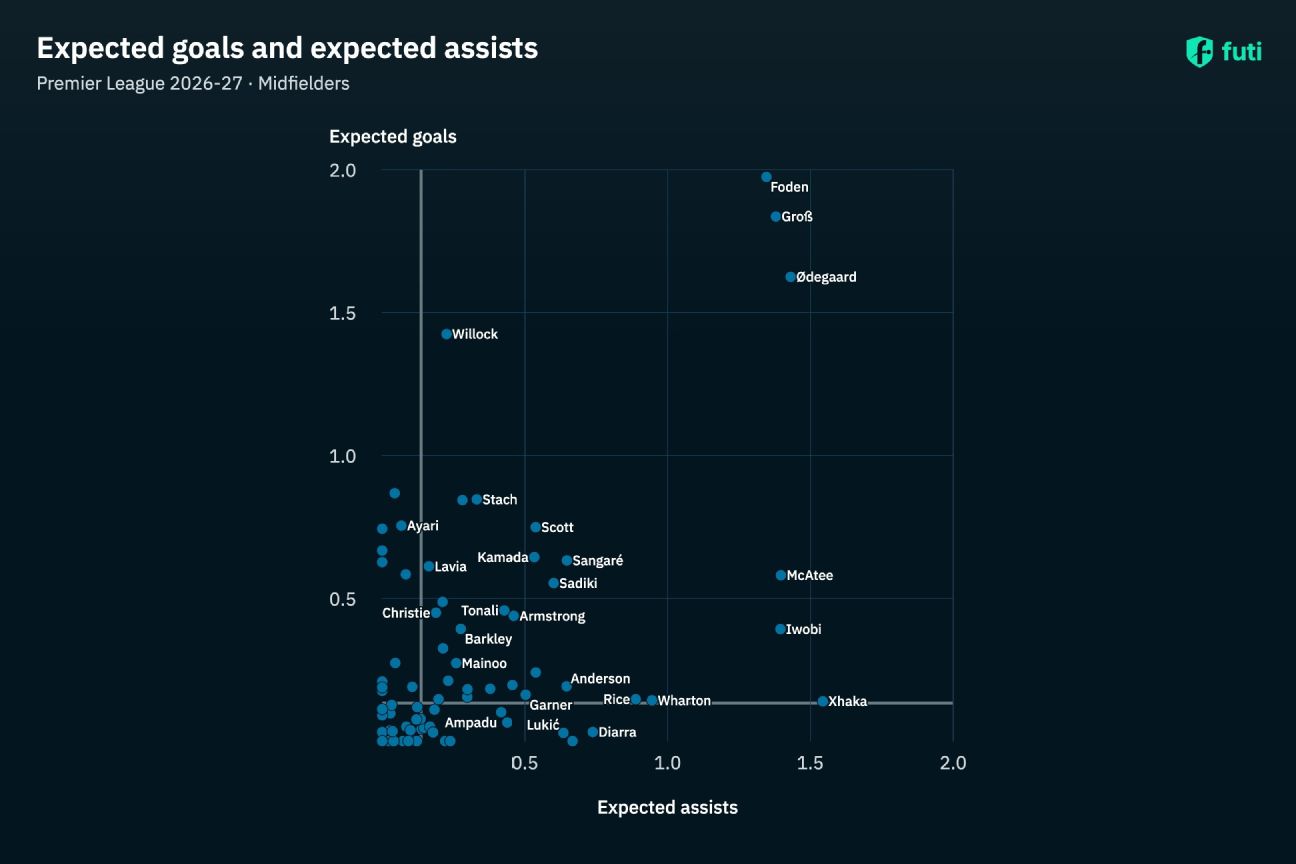
You'll notice three players in the upper right: Arsenal captain Martin Ødegaard, former Premier League Player of the Year Phil Foden and ... 35-year-old Pascal Gross. That's shocking enough on its face...
But then just take a look at where he's actually touching the ball:
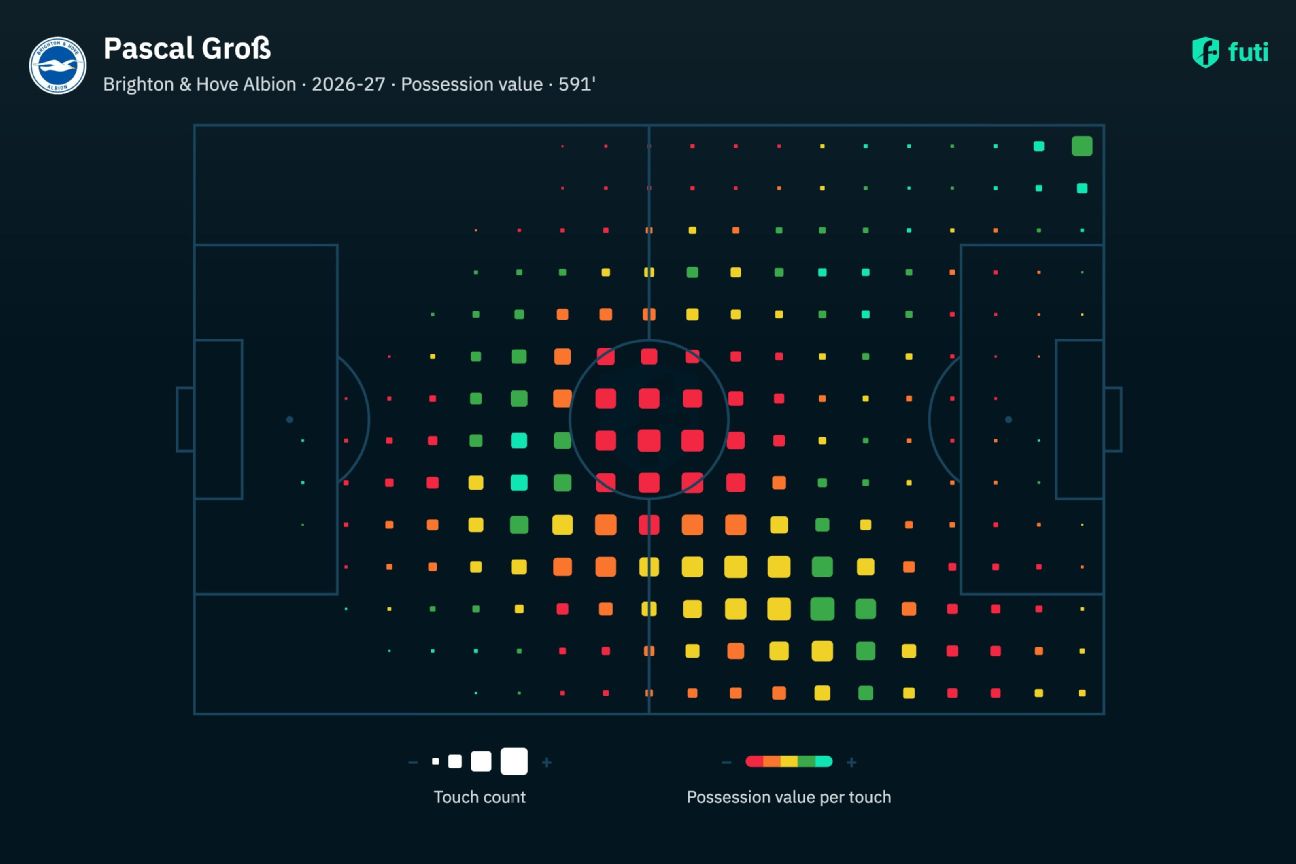
Most of Gross's touches are coming in the middle third or the right half-space -- the Kevin De Bruyne zone -- just on the edge of the attacking third. Only Brighton's center backs, Lewis Dunk and Luka Vuskovic, have attempted more passes than Gross this season.
Gross is not a low-touch midfielder who only needs to contribute around the penalty area. No, he's a high-touch midfielder who is also contributing around the penalty area -- in the toughest league in the world, for the team currently in third place, at 35 years old!
He's one of the most underrated players in Premier League history: a truly elite passer who has done it for a decade straight.
26. Phil Foden, attacking midfielder, Manchester City
It was all going so well for Foden, too.
After literally winning the Premier League Player of the Season award in 2023-24, Foden quickly fell out of favor with manager Pep Guardiola. It's not like he never played, but he was never a clear first-choice option over the past two seasons.
After starting for England at Euro 2024, he didn't even make the roster for this past summer's World Cup despite being fully healthy.
But this season, he started four of City's first five matches in the league and in the Champions League, and he looked much closer to the guy we saw three seasons ago. Then he kicked Bruno Fernandes, got a straight red card and was suspended for City's final match before the international break during which City were found guilty of 114 different cheating charges.
Even if Foden comes back into the lineup -- and he should because he has been way more productive than Antoine Semenyo or Iliman Ndiaye -- and picks up where he left off, then what will it really mean?
With what's expected to be a severe punishment looming in the background, City's matches currently exist in a netherworld where they seem to mean everything and nothing at the same time. Each City match is going to be the most important match every weekend -- the team the league says cheated, still playing in that league -- but we all expect there to be some kind of punishment that likely renders those results moot.
And after that punishment happens, the games could enter into an even stranger realm of un-meaning: where City win most of their games and still finish in last, or where City stop trying in the Premier League and focus all their efforts on Europe.
But, uh, yeah: Phil Foden seemed like he was back, for a couple of games.
25. Cole Palmer, attacking midfielder, Chelsea
24. João Pedro, striker, Chelsea
23. Jan Paul van Hecke, center back, Tottenham Hotspur
22. Jurriën Timber, right back, Arsenal
21. Nico O'Reilly, left back, Manchester City
20. Reece James, right back, Chelsea
19. Enzo Fernández, central midfielder, Manchester City
18. Josko Gvardiol, center back, Manchester City
17. Bruno Guimarães, central midfielder, Arsenal
16. Riccardo Calafiori, left back, Arsenal
This statement is true: manager Mikel Arteta has relied quite heavily on players who used to be center backs to play fullback for his team.
This statement is also true: That has mostly been a conservative decision, one that has helped Arsenal become the best defensive team in the world but also one that has hamstrung the team's attacking proficiency in open play and required them to become the greatest set piece team we've ever seen.
Another true statement: The majority of Calafiori's minutes before joining Arsenal -- both with Italy and with Bologna -- were played as a center back on the left side of a back three.
And now a false statement: Calafiori is just like all the other defense-first center backs Arteta converted to fullback.
Calafiori is a better defender than your average fullback, especially in the air, but "conservative" is one of the last words I'd use to describe him. Check out where he's touching the ball this season:
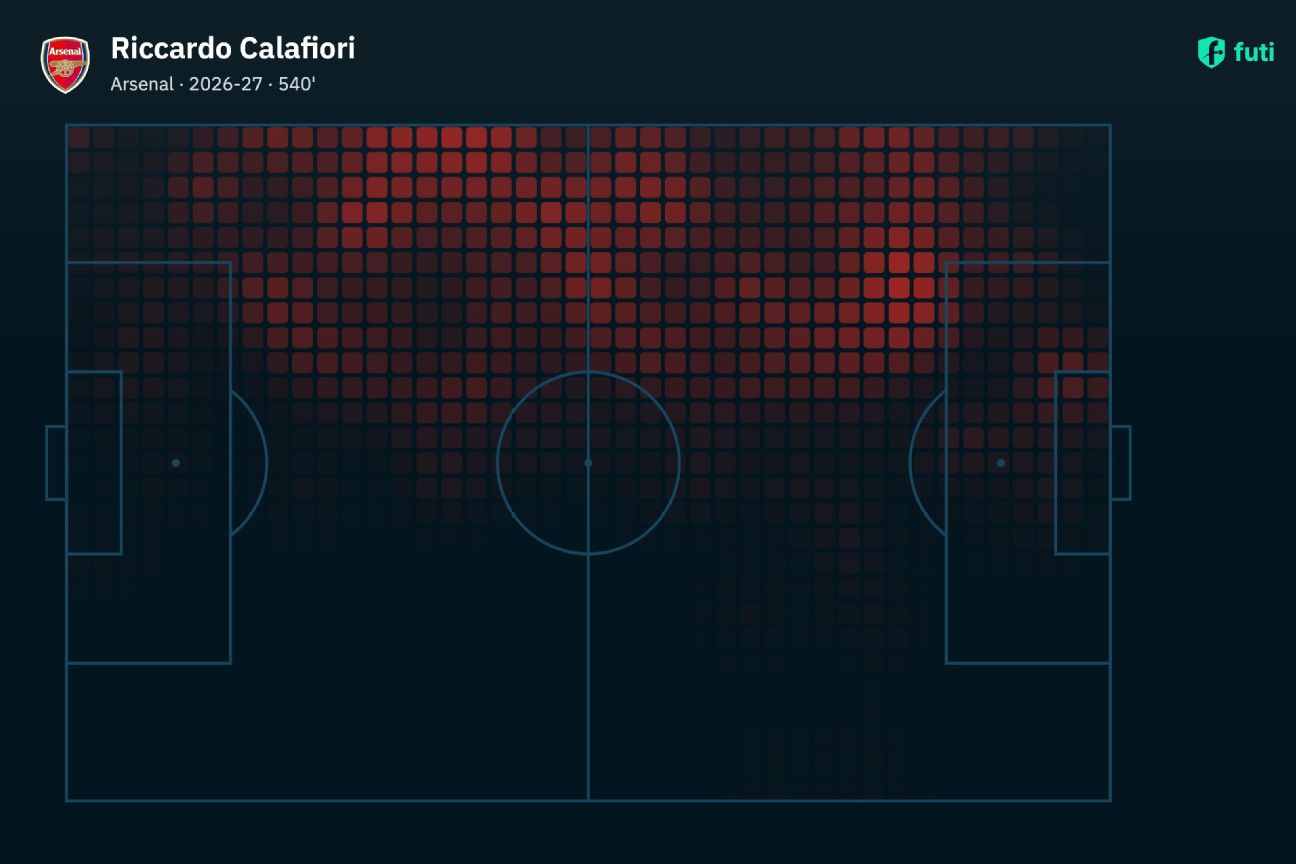
Let's just follow it from left to right: starts off pretty normal. In his own half, he's staying wide like most fullbacks do, providing a wide passing option and opening up space between the lines for a midfielder to receive a pass. That remains mostly true in the middle third; he gets a little zanier and comes in field to create rotations that help Arsenal break into the attacking third, but he's still mostly out wide.
Once he's in the attacking third, though? Pretty much anything can happen -- other than what you'd expect. See how there's barely anything along the sideline once you cross past the top of the box? The one thing Calafiori doesn't do is the one thing every other attacking fullback has always done: overlap his winger.
Based on where a player actually touches a ball and what he does with it, Futi's data classifies players into a spectrum of roles. Some 53% of the time it sees Calafiori as a wide defender; 13% of the time he's a central attacker (basically a No. 10); 16% of the time he's a wide attacker; and 18% of the time? The model thinks he's playing as a forward.
15. Rúben Dias, center back, Manchester City
14. Virgil van Dijk, center back, Liverpool
13. Dominik Szoboszlai, central midfielder, Liverpool
12. Elliot Anderson, central midfielder, Manchester City
11. Bryan Mbeumo, winger, Manchester United
He's not a superstar, and maybe he shouldn't be this high. But at a time when it seems like most of the truly devastating attacking players are currently playing outside of England, it feels especially valuable to have a player who is going to give you something reliable.
Really, Mbeumo might be the most consistent attacker in the league. Over the past four seasons, he's averaging the following, in order, for non-penalty goals+assists per 90 minutes: 0.50, 0.55, 0.58, 0.48. That averages out to around 0.51 goals+assists per 90 minutes. This season? He's at 0.5.
Throw in a little bit of everything else -- passing, carrying, off-ball running, defensive effort -- and his impact is even a little more valuable than what those numbers suggest.
10. Martin Ødegaard, attacking midfielder, Arsenal
9. Moisés Caicedo, defensive midfielder, Chelsea
8. Marc Guéhi, center back, Manchester City
After some hiccups once he joined Man City midway through last season, he has been the best center back in the league so far this season. He even spent significant minutes as a midfielder and played quite well.
Perhaps the biggest compliment I can give him is that although he's only 6-foot tall -- quite small for a center back -- you never really notice it when you watch him play.
7. Jérémy Doku, winger, Manchester City
6. Gabriel Magalhães, center back, Arsenal
5. Bruno Fernandes, attacking midfielder, Manchester United
4. Rayan Cherki, attacking midfielder, Manchester City
3. Bukayo Saka, winger, Arsenal
2. Declan Rice, central midfielder, Arsenal
1. Erling Haaland, striker, Manchester City
We're just six games into the season, and I feel comfortable making a conclusion: There's a clear top tier of players in the Premier League, and it consists of the four guys at the top of these rankings.
Cherki is playing a starter's load finally, and that has led to is him leading the league in expected assists. Oh, and he's ninth in non-penalty expected goals. There's not a single player in Europe that I'd rather have on the ball against a packed-in defense.
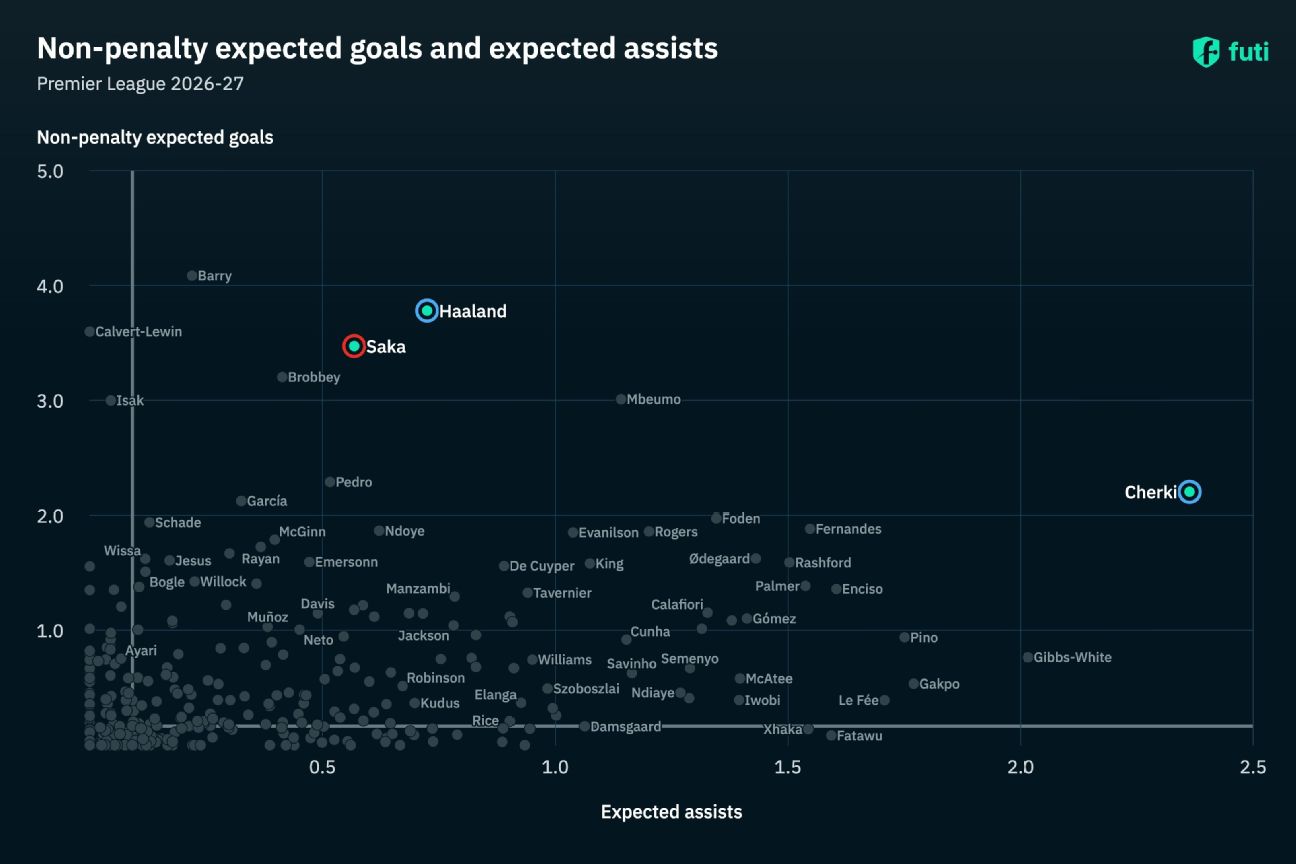
As you can see above, Bukayo Saka might be making a leap in front of goal, and he's still one of the best dribblers in the league and probably the best defender in Europe among the guys who can consider themselves elite attackers.
Rice, meanwhile, continues to be excellent at every aspect of the sport, in every area of the field, in any phase of the game. I'm running out of things to say about him, so I just say the same thing every single time.
... As I do with Haaland: There's nothing new here. He's involved in 3% of Man City's phases of play -- near the bottom of the league. And yet he leads the league in goals. He has 118 in 133 Premier League starts.
How many more will he get? All of a sudden, that's a question with a bunch of different answers.
